The Complete Guide to Japanese Sushi: History, Terminology, Etiquette & Allergen Rules

Sushi is perhaps Japan's most celebrated culinary gift to the world, but the delicate art of hand-pressed seafood and vinegared rice carries a rich centuries-old history, distinctive dining customs, and a specialized vocabulary that extends far beyond the familiar California roll.
In Japan, sushi is more than simply raw fish. It is a culinary tradition built around the relationship between seasoned rice, carefully selected ingredients, preparation techniques, and matching the changing seasons. From humble beginnings as a method of preserving fish to the sophisticated craftsmanship of contemporary sushi counters, its evolution reflects Japan's agricultural history, maritime culture, and enduring attention to detail.
Whether stepping into an approachable conveyor-belt restaurant (kaitenzushi) or reserving a seat at an intimate omakase counter in Tokyo, understanding sushi's history, terminology, etiquette, and dietary considerations will make the experience considerably more rewarding.

1. The History of Sushi: From Preservation to Fast Food
Sushi did not originate as the fresh, beautifully presented delicacy familiar today. Its earliest forms developed from methods of preserving fish through salting and fermentation.
Narezushi: The Fermented Origins
Early forms of fermented fish preserved in rice developed in parts of Asia before spreading to Japan. One of the oldest Japanese styles, narezushi, involved packing salted fish with cooked rice and allowing it to ferment over an extended period. The rice helped facilitate fermentation and was traditionally discarded, leaving the preserved fish to be eaten. This preparation differed dramatically from modern sushi in both flavor and texture.
A surviving example is funazushi, a specialty of Shiga Prefecture made from fermented crucian carp associated with Lake Biwa. Its strong aroma and intensely sour flavor provide a fascinating glimpse into sushi's preservation-based origins.
The Edo Period: The Birth of Modern Nigiri
During the Edo period (1603–1868), the growth of cities, improvements in food distribution, and the increasing use of rice vinegar transformed sushi into a quicker, more convenient meal. By the early 19th century, Edomae-zushi—the predecessor of modern nigiri—had become popular in Edo, present-day Tokyo. Chef Hanaya Yohei is widely credited with helping popularize this style, which featured hand-pressed vinegared rice topped with seafood. The name Edomae originally referred to the waters in front of Edo, particularly Edo Bay, now Tokyo Bay.
Importantly, early nigiri toppings were not always served completely raw. Fish and shellfish were frequently salted, marinated, simmered, or otherwise prepared to preserve quality and enhance flavor. Sushi was also originally much larger than the delicate individual pieces served today. Sold from street stalls known as yatai, it functioned as a convenient fast food for the bustling capital.
The Modern Era: Refrigeration & Global Expansion
Refrigeration, improved transportation, and changing dining habits transformed sushi during the 20th century. Fresh seafood could be distributed over greater distances, while specialized sushi restaurants increasingly emphasized craftsmanship and seasonal ingredients. In 1958, the first conveyor-belt sushi restaurant opened in Osaka under the leadership of restaurateur Yoshiaki Shiraishi. The concept made sushi more accessible by allowing diners to select dishes directly from a moving conveyor. Today, sushi ranges from inexpensive neighborhood meals to highly specialized dining experiences, with regional styles and modern interpretations found throughout Japan and across the world.

2. Important Sushi Terminology
Understanding a handful of essential terms can make ordering considerably easier, particularly at traditional sushi counters where English menus may be limited.
Term | Meaning |
Shari (シャリ) | Seasoned sushi rice, prepared with vinegar, sugar, and salt in varying proportions |
Neta (ネタ) | The topping placed on sushi rice, commonly seafood but not exclusively |
Gari (ガリ) | Thinly sliced pickled ginger served as a palate cleanser |
Wasabi (わさび) | Japanese wasabi, traditionally grated and used to complement seafood |
Murasaki (むらさき) | Traditional sushi-counter slang for soy sauce |
Agari (あがり) | Tea served at a sushi restaurant |
Omakase (おまかせ) | A dining arrangement in which the chef selects the dishes |
Okonomi (お好み) | Ordering individual pieces according to personal preference |
Aburi (炙り) | A preparation in which the surface of an ingredient is lightly seared |
Zuke (漬け) | Seafood, often tuna, marinated in a seasoned sauce |
Tamago (玉子) | Japanese-style egg preparation commonly served as sushi |
Understanding the Importance of Shari
Although seafood often receives the greatest attention, sushi rice is fundamental to the dish. It must achieve a careful balance of temperature, moisture, texture, and seasoning. At traditional sushi counters, chefs may adjust the vinegar blend or rice temperature to complement specific toppings. The ideal result is a piece that holds together when lifted but separates gently in the mouth. This is one reason sushi is best eaten soon after it is prepared.
Real Wasabi vs. Common Substitutes
Authentic Japanese wasabi comes from the rhizome of Eutrema japonicum, a plant traditionally cultivated in cool, flowing water environments. Freshly grated wasabi has a distinctive aromatic sharpness that fades relatively quickly. Because genuine wasabi is expensive and difficult to cultivate, many restaurants use preparations made primarily from horseradish, mustard, and coloring. Both may be labeled wasabi on menus, but they offer noticeably different flavor profiles.

3. The Different Types of Sushi
Although nigiri is perhaps the most recognizable traditional form, Japanese sushi encompasses a wide variety of preparations.
Sushi type | Description |
Nigiri (握り寿司) | Hand-formed vinegared rice topped with seafood, egg, or another ingredient |
Hosomaki (細巻き) | Thin sushi rolls, usually containing one principal filling |
Futomaki (太巻き) | Thick rolls containing multiple fillings |
Gunkan-maki (軍艦巻き) | Rice surrounded by a tall strip of nori, designed to hold loose toppings |
Temaki (手巻き) | Hand-rolled nori cones filled with rice and assorted ingredients |
Chirashizushi (ちらし寿司) | Vinegared rice topped or mixed with assorted ingredients, with regional variations |
Oshizushi (押し寿司) | Pressed sushi, traditionally associated with parts of western Japan |
Inarizushi (いなり寿司) | Sushi rice enclosed in seasoned fried tofu pockets |
Sashimi (刺身) | Sliced seafood served without sushi rice; technically not sushi |
Regional Sushi Traditions
Japanese sushi is not uniform across the country.
Tokyo: Edomae-zushi
Tokyo is particularly associated with traditional nigiri, emphasizing carefully prepared seafood and seasoned rice. Classic techniques include marinating, curing, simmering, and brushing toppings with sauces.
Osaka: Oshizushi
Osaka has a long tradition of pressed sushi, in which rice and toppings are compressed into carefully shaped portions using a wooden mold. This style reflects the historical importance of preservation and commercial food culture in the Kansai region.
Kyoto: Saba-zushi
Kyoto is particularly associated with saba-zushi, a preparation featuring cured mackerel and sushi rice. Historically, preserved seafood was especially important in inland Kyoto, where fresh marine fish had to be transported from coastal regions.
Shiga: Funazushi
The fermented fish tradition of Lake Biwa represents one of the closest surviving connections to sushi's earliest preservation methods. For culinary enthusiasts, these regional differences offer an opportunity to explore Japanese food history beyond familiar nigiri and maki rolls.
4. Understanding the Omakase Experience
Omakase translates roughly to "I'll leave it up to you," indicating that the diner entrusts the selection and progression of dishes to the chef. At a traditional sushi counter, an omakase experience may feature a carefully structured sequence of seasonal seafood, prepared individually and served directly to the guest. The chef considers the flavor, texture, richness, and temperature of each piece when determining the progression.
What to Expect
Reservations: Many high-end sushi restaurants require advance reservations, sometimes weeks or months ahead.
Punctuality: Arrive on time. Some establishments serve all guests simultaneously, and late arrivals may disrupt the experience.
Seasonality: The menu changes according to the availability and quality of seafood.
Pricing: Omakase experiences vary enormously in cost. Confirm the price, service charges, cancellation policies, and whether beverages are included before booking.
Dietary Restrictions: Notify the restaurant of allergies and restrictions well in advance. Some establishments cannot accommodate substitutions during a fixed omakase service.
Respecting the Chef's Craft
At intimate sushi counters, diners can observe the preparation process firsthand. Sushi is generally intended to be eaten promptly after serving, while the temperature and texture remain as prepared. Photography may be permitted, but always check before photographing chefs, other guests, or the preparation area. Avoid using flash photography and do not interrupt the chef during particularly busy moments.
Destination Loading Field Note: Omakase does not automatically mean formal luxury dining. Japan offers a wide range of chef-selected experiences, including approachable lunch menus and smaller neighborhood establishments.
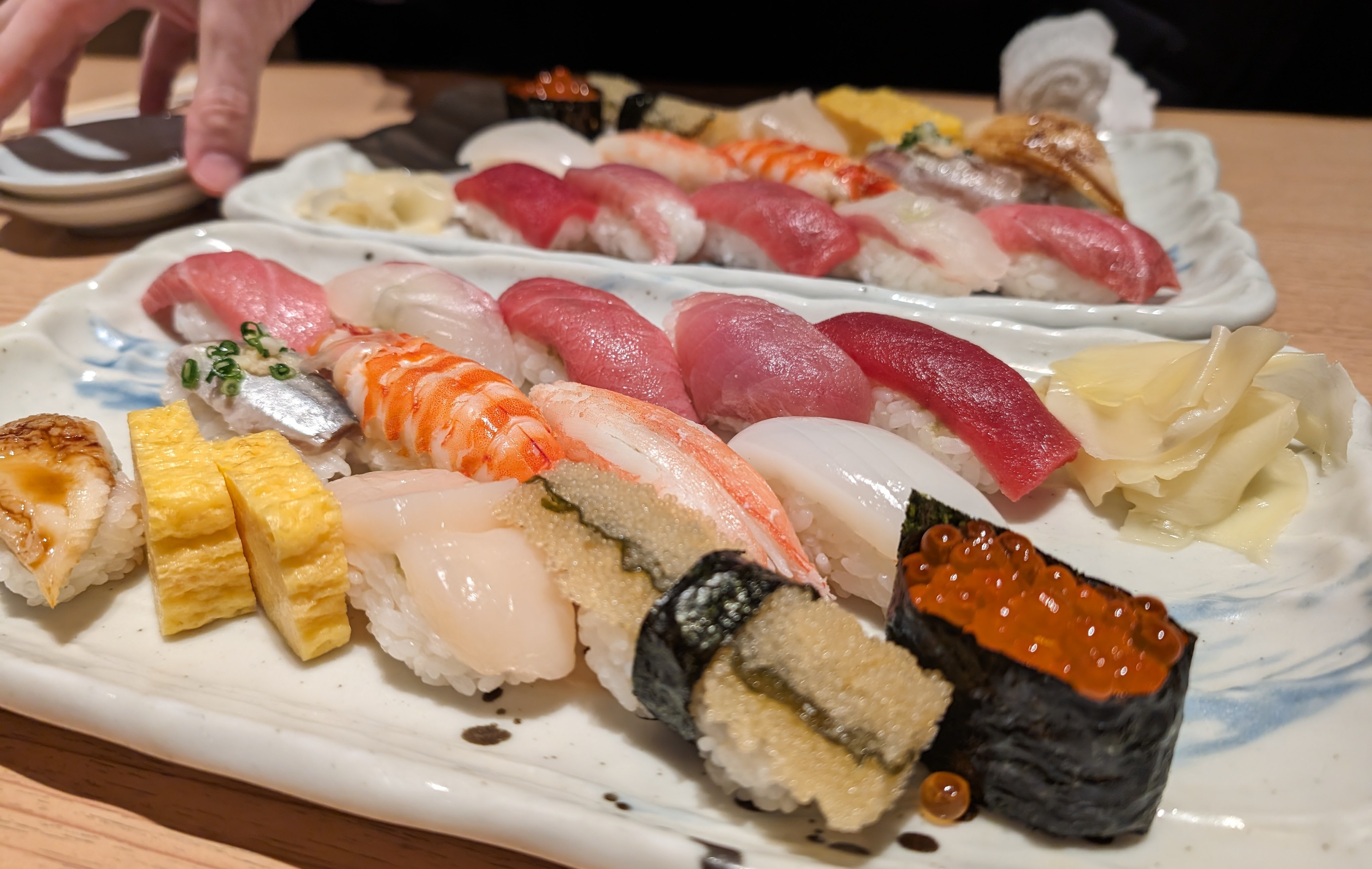
5. Sushi Etiquette: How to Eat Respectfully
Japanese sushi etiquette emphasizes appreciation for the ingredients, the chef's preparation, and the dining experience. While customs vary by establishment, a few principles are especially useful for first-time visitors.
Hands or Chopsticks?
Both are acceptable for eating nigiri. Using clean fingers is a traditional approach and can make delicate pieces easier to handle without disturbing the rice. Chopsticks are equally appropriate, particularly for sashimi and other preparations. There is no need to force yourself to use one method over the other.
Soy Sauce: Less Is More
When dipping nigiri into soy sauce, gently touch the seafood side to the sauce rather than soaking the rice. Rice absorbs liquid quickly and can fall apart if heavily dipped. At high-end sushi counters, some pieces are already seasoned or brushed with a sauce called nikiri. If the chef has finished the piece with sauce or salt, additional soy sauce may be unnecessary.
Wasabi & Ginger
Wasabi is traditionally placed between the rice and seafood in many nigiri preparations. At formal sushi counters, the chef may already have adjusted the amount to complement the topping. Mixing wasabi into soy sauce is common in casual dining, but it is generally unnecessary when eating carefully seasoned omakase sushi.
Pickled ginger, or gari, is intended to refresh the palate between different pieces. Rather than placing it on top of nigiri, enjoy a small amount between bites.
One Bite or Two?
Sushi is commonly prepared to be eaten in a single bite, allowing the rice and topping to be experienced together. However, pieces vary in size, and there is no need to force an uncomfortable bite. If necessary, eat the piece carefully in two bites.
Following the Chef's Sequence
When enjoying omakase, eat pieces in the order served. If ordering individually, a traditional progression often begins with lighter fish before moving toward richer or more strongly flavored varieties. However, there is no universal requirement to follow a particular sequence at casual sushi restaurants.

6. Chopstick Etiquette: Essential Japanese Dining Customs
Chopsticks (hashi, 箸) are an integral part of Japanese dining culture, and their use carries traditions rooted in courtesy, shared meals, and religious symbolism. While visitors are not expected to master every custom, understanding a few fundamental rules helps avoid unintentional disrespect, particularly in traditional restaurants and formal dining settings.
The Do's of Chopstick Etiquette
Use both chopsticks together: Chopsticks should function as a pair, gently gripping food rather than digging, stabbing, or scooping.
Use a chopstick rest: When pausing between bites, place your chopsticks on the provided hashioki (chopstick rest). If none is available, a clean paper chopstick sleeve may serve as a temporary rest.
Use serving utensils: When taking food from communal dishes, use the provided serving chopsticks or utensils rather than your personal pair.
Handle food gently: Pick up manageable portions without repeatedly poking through a dish or rearranging its contents.
Chopstick Taboos: What to Avoid
Several chopstick customs are closely associated with Japanese funeral rituals, making them particularly important to understand.
Never Stand Chopsticks Upright in Rice
Placing chopsticks vertically into a bowl of rice resembles a ritual offering made for the deceased and is considered inappropriate during ordinary meals.
Never Pass Food Between Chopsticks
Passing food directly from one person's chopsticks to another's resembles a Japanese cremation ritual in which family members transfer bone fragments using special chopsticks. Instead, place food onto a plate for the other person to pick up.
Avoid Pointing or Gesturing
Do not point at people, wave chopsticks while speaking, or use them to move plates and bowls around the table.
Do Not Spear or Search Through Food
Stabbing food with chopsticks or moving ingredients around a shared dish to find preferred pieces is generally considered poor manners.
Avoid Rubbing Disposable Chopsticks Together
Rubbing wooden disposable chopsticks together to remove splinters can suggest dissatisfaction with their quality. If a pair is genuinely damaged, request a replacement.
A Note on Japanese Dining Customs
Many chopstick taboos have specific names, including tate-bashi (standing chopsticks upright), watashi-bashi (resting chopsticks across a bowl), and sashi-bashi (spearing food). These traditions reflect the cultural importance of respectful behavior at the table.
Destination Loading Field Note: Chopsticks are common at most Asian meals, although not required every time. Sushi may be eaten with clean hands, and dishes such as curry rice are commonly eaten with a spoon. Use the utensils appropriate to the dish rather than assuming chopsticks are always expected.
7. How to Use Chopsticks: A Beginner's Practical Guide
For travelers unfamiliar with chopsticks, learning the basic grip before arriving in Japan can make dining considerably more comfortable. The key is understanding that one chopstick remains relatively stationary while the other moves to grip and release food.
Step 1: Position the Lower Chopstick
Place the first chopstick between the base of your thumb and the side of your ring finger.
This chopstick should remain stable throughout the movement.
Step 2: Position the Upper Chopstick
Hold the second chopstick between your thumb, index finger, and middle finger, similar to holding a pencil.
Your index and middle fingers will control most of its movement.
Step 3: Practice Opening & Closing
Keep the lower chopstick steady while moving the upper chopstick up and down.
Bring the tips together gently, ensuring they align without crossing.
Step 4: Practice Picking Up Food
Begin with larger, easy-to-grip foods before progressing to smaller or slippery ingredients.
Use the tips of the chopsticks to secure the food with gentle, controlled pressure.
Avoid gripping too tightly, as excessive force can cause food to slip or break apart.
Step 5: Develop Control Through Practice
Practice lifting different foods, gradually progressing from larger pieces to smaller items such as beans or individual grains. With repetition, the movement becomes increasingly natural.
Practical Tips for Beginners
Start with manageable portions: Larger pieces are often easier to control than small, slippery ingredients.
Keep your grip relaxed: Excessive tension makes precise movements more difficult.
Avoid crossing the tips: Proper alignment helps maintain control.
Take your time: There is no need to rush or imitate the speed of experienced diners.
Ask for alternative utensils when needed: Using a fork or spoon is preferable to struggling through an entire meal.
Destination Loading Field Note: Chopsticks act as a natural tool for mindful eating, promoting smaller portion sizes that reduce overall calorie consumption. By forcing a slower dining pace, they allow the body to properly signal fullness while encouraging thorough chewing for smoother, more efficient digestion.

8. Dietary Restrictions, Allergens & Food Safety
Sushi can present challenges for travelers with food allergies, dietary restrictions, or concerns about consuming raw seafood. Ingredients are not always obvious from the appearance of a dish, and even preparations without visible seafood may contain fish-derived seasonings.
Common Allergens & Hidden Ingredients
Fish: Tuna, salmon, mackerel, sea bream, and many other varieties are central to sushi menus.
Crustaceans: Shrimp and crab appear in nigiri, rolls, tempura, and prepared seafood mixtures.
Mollusks: Scallops, clams, squid, and octopus are common ingredients and require separate consideration from crustacean allergies.
Soy: Soy sauce, miso-based seasonings, and certain marinades may contain soy.
Wheat: Standard Japanese soy sauce commonly contains wheat. Travelers with wheat allergies or celiac disease should confirm ingredients rather than assuming a dish is gluten-free.
Egg: Tamago sushi, mayonnaise-based sauces, and some prepared toppings contain egg.
Sesame: Sesame seeds and sesame-based seasonings may appear in rolls, sauces, and garnishes.
Fish Stock: Dashi made with bonito flakes may appear in cooked egg, sauces, soups, and other preparations.
Cross-Contact Considerations
Sushi restaurants frequently use shared knives, cutting boards, utensils, and preparation surfaces for multiple types of seafood. Even when a particular ingredient is omitted, cross-contact may remain possible. Travelers with severe allergies should communicate their needs before booking and confirm that the restaurant can safely accommodate them. A translated allergy card identifying the exact allergen and severity is considerably more reliable than relying on a short spoken phrase alone.
Essential Japanese Allergy & Dietary Phrases
English | Japanese | Pronunciation |
I have a food allergy. | 食物アレルギーがあります。 | Shokumotsu arerugī ga arimasu. |
I am allergic to shrimp. | エビアレルギーがあります。 | Ebi arerugī ga arimasu. |
I am allergic to crab. | カニアレルギーがあります。 | Kani arerugī ga arimasu. |
I am allergic to fish. | 魚アレルギーがあります。 | Sakana arerugī ga arimasu. |
I cannot eat raw fish. | 生魚は食べられません。 | Namazakana wa taberaremasen. |
Without wasabi, please. | サビ抜きでお願いします。 | Sabi-nuki de onegaishimasu. |
Is this raw or cooked? | これは生ですか、加熱されていますか? | Kore wa nama desu ka, kanetsu sarete imasu ka? |
No soy sauce, please. | 醤油なしでお願いします。 | Shōyu nashi de onegaishimasu. |
Does this contain wheat? | これに小麦は入っていますか? | Kore ni komugi wa haitte imasu ka? |
Important: These phrases help communicate dietary needs, but they do not guarantee that a meal is allergen-free. Severe allergies require confirmation of ingredients, preparation practices, and cross-contact precautions. Bringing with you a translated card with a list of allergies is a wonderful traveler hack.
Raw Fish & Food Safety
Raw seafood carries inherent foodborne illness risks, including parasites and bacterial contamination. Reputable sushi restaurants use sourcing, handling, refrigeration, and other food-safety practices intended to reduce these risks. Pregnant travelers, people with weakened immune systems, and others at elevated risk from foodborne illness should seek appropriate medical guidance and consider fully cooked alternatives. Fortunately, sushi is not synonymous with raw fish. Cooked shrimp, grilled eel, tamago, vegetable rolls, and inarizushi provide opportunities to enjoy sushi without consuming raw seafood.
9. Conveyor-Belt Sushi: An Accessible Introduction
Conveyor-belt sushi, known as kaitenzushi, offers an approachable introduction to Japanese sushi culture. Traditionally, plates circulate past diners on a moving conveyor, allowing guests to select dishes as they pass. However, many contemporary restaurants now use touchscreen ordering systems and dedicated delivery lanes to minimize touchpoints, meaning food may arrive directly at the table rather than circulating continuously.
How to Navigate Kaitenzushi
Seating: Follow the host's instructions or use the restaurant's automated seating system.
Ordering: Depending on the restaurant, choose plates from the conveyor or order through a touchscreen.
Plate Pricing: Many restaurants use different plate colors to indicate prices, while others charge according to individual menu selections.
Tea & Condiments: Green tea powder, hot-water dispensers, soy sauce, ginger, and other condiments are typically provided at the table.
Payment: Follow the restaurant's system for plate collection, automated counting, or checkout.
Conveyor-Belt Etiquette
Never return a plate to the conveyor after removing it.
Do not touch food or plates that you do not intend to take.
Follow the restaurant's instructions for ordering and returning used plates.
Supervise children around moving conveyors and hot-water dispensers.
Keep shared condiments and serving areas clean.
Destination Loading Field Note: Kaitenzushi is an excellent place to become familiar with sushi terminology before visiting a traditional counter. Many restaurants provide photographs, multilingual menus, and clearly displayed prices.

10. A Beginner's Guide to Ordering Sushi
For travelers unfamiliar with Japanese seafood varieties, the following ingredients offer a useful starting point.
Japanese name | English | Flavor & characteristics |
Maguro (まぐろ) | Tuna | Firm texture, clean savory flavor |
Chūtoro (中トロ) | Medium-fatty tuna | Richer, softer texture |
Ōtoro (大トロ) | Fatty tuna | Highly marbled and buttery |
Sake / Shake (サケ / シャケ) | Salmon | Rich, smooth flavor |
Tai (鯛) | Sea bream | Delicate, mild white fish |
Hirame (ヒラメ) | Flounder | Subtle flavor, firm texture |
Ebi (エビ) | Shrimp | Sweet, commonly served cooked |
Hotate (ホタテ) | Scallop | Delicate sweetness |
Ikura (イクラ) | Salmon roe | Briny, bursting texture |
Uni (ウニ) | Sea urchin | Creamy, intensely marine flavor |
Unagi (うなぎ) | Freshwater eel | Rich, commonly grilled with sauce |
Tamago (玉子) | Japanese egg | Soft, mildly sweet preparation |
Suggested Tasting Progression
If ordering piece by piece, begin with lighter varieties such as tai or hirame. Progress toward more pronounced flavors, including tuna and silver-skinned fish such as saba. Finish with richer preparations such as chūtoro, ōtoro, or grilled eel. This is a useful tasting approach rather than a mandatory dining rule.
11. Destination Loading's Sushi Field Notes
A few practical considerations can make your sushi experience smoother and more enjoyable.
Reserve ahead for omakase: Popular counters may have limited seating and strict cancellation policies.
Confirm dietary restrictions before booking: Some restaurants cannot accommodate seafood allergies or extensive ingredient substitutions.
Understand the price structure: Omakase menus, individual nigiri orders, and conveyor-belt plates follow different pricing systems.
Look beyond tuna and salmon: Regional fish, shellfish, cured preparations, and seasonal specialties reveal the diversity of Japanese sushi.
Avoid excessive fragrance: Strong perfumes can interfere with the delicate aromas of seafood at intimate sushi counters.
Eat promptly: Freshly prepared nigiri is generally intended to be enjoyed immediately.
Respect photography policies: Ask before photographing chefs, preparation areas, or other guests.
Try regional specialties: Sushi traditions in Tokyo, Kyoto, Osaka, and Shiga offer distinctly different culinary experiences.
Final Thoughts: Understanding the Art Behind Sushi
Japanese sushi represents far more than an assortment of seafood arranged over rice. Its history reflects centuries of adaptation, from fermented preservation techniques to Edo-period street food and the refined craftsmanship of contemporary sushi restaurants. Every element—from the seasoning and temperature of the rice to the preparation of individual toppings—contributes to a culinary tradition shaped by regional geography, seasonal availability, and generations of specialized knowledge.
For travelers, understanding these details transforms sushi from a familiar meal into a deeper cultural experience. Whether enjoying a simple plate of nigiri at a neighborhood restaurant, discovering Kyoto's preserved mackerel sushi, or observing a chef prepare an omakase progression, the most rewarding experiences come from approaching Japanese cuisine with curiosity, respect, and a willingness to explore beyond the familiar.
Plan smarter. Travel deeper.



Great info! Lived learning the history and now I’m craving sushi!! 🍣