Kyoto Travel Etiquette Guide: Essential Rules, Cultural Norms, and Historical Facts

How to navigate Kyoto's sacred sites with cultural respect, local etiquette, and timeless historical context.

Understanding Kyoto's Garden Philosophy
A common mistake among visitors is to evaluate Kyoto's temples primarily by their size, age, or photographic appeal.
Yet many of the city's most meaningful spaces were designed around philosophical principles that become apparent only through careful observation.
Karesansui: The Art of the Dry Landscape
Karesansui, often called the Japanese dry landscape garden, uses carefully arranged stones, gravel, sand, and occasionally moss to evoke natural scenery without relying on literal representations. A cluster of stones may suggest mountains or islands, while raked gravel can evoke water or the movement of waves.
These gardens are frequently associated with Zen Buddhist institutions, although their historical development reflects a broader range of artistic and religious influences.
Their apparent simplicity conceals considerable attention to proportion, perspective, negative space, and the relationship between observer and landscape.
Wabi-sabi: Beauty in Impermanence and Imperfection
The aesthetic concept commonly described as wabi-sabi emphasizes qualities such as simplicity, weathering, modesty, and the beauty of impermanence.
A moss-covered stone lantern, uneven timber beam, or aged garden wall can possess an aesthetic value that a perfectly polished surface cannot replicate.
Rather than viewing signs of age as imperfections to be corrected, Japanese aesthetic traditions have often found beauty in the visible passage of time.
The concept is more complex than a single design philosophy, but it offers a useful starting point for understanding why Kyoto's quietest spaces can be so visually powerful.
Shakkei: Borrowing the Landscape
Another important principle is shakkei, or "borrowed scenery." Through this technique, garden designers incorporate distant mountains, wooded hillsides, or surrounding landscapes into a composed garden view. The garden's boundaries become visually expanded, creating the impression that the cultivated space continues into the natural environment beyond.
This integration of architecture, horticulture, and landscape is among the most distinctive qualities of Kyoto's historic gardens.
Ethical Travel in Kyoto: Respecting a Living City
Overtourism in Kyoto is not simply an inconvenience for visitors. It has measurable consequences for residents, local businesses, religious institutions, and the preservation of historic neighborhoods.
Narrow streets designed long before modern mass tourism must now accommodate pedestrians, delivery vehicles, bicycles, taxis, and large numbers of sightseers.
Residential neighborhoods can experience noise, congestion, intrusive photography, and disruptions to daily routines.
In response, local authorities and community organizations have introduced measures intended to encourage more responsible visitor behavior, and travelers can contribute meaningfully by adopting a few simple principles.
Respect Private Streets and Residential Boundaries
Kyoto's historic districts are not open-air film sets. Some picturesque lanes, particularly in Gion, are private property or have restrictions on tourist access and photography.
Visitors should observe posted signs, remain on permitted public routes, and avoid entering residential courtyards or private passages. An attractive photograph is never justification for trespassing.
Understand Geiko and Maiko Etiquette
Kyoto's traditional entertainment districts are closely associated with geiko and maiko, professional practitioners of Japanese performing arts.
Geiko are Kyoto's term for geisha, while maiko are apprentices undergoing training in traditional performance, dance, music, and hospitality.
These women are not costumed tourist attractions. Following, touching, obstructing, or aggressively photographing geiko and maiko is inappropriate and can interfere with their professional responsibilities. If you encounter one walking through Gion, allow her to continue without interruption.
For travelers interested in the cultural traditions of Kyoto's entertainment districts, a legitimate scheduled performance or cultural program is a far more respectful way to learn.
Practice Appropriate Temple and Shrine Etiquette
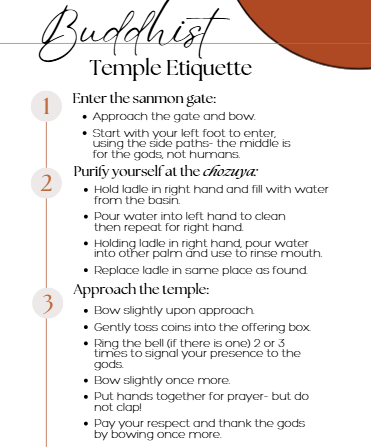
Shinto shrines and Buddhist temples follow different religious traditions, although both may feature ritual purification, offerings, and established forms of respectful behavior.
At both, visitors may encounter a, chozuya or temizuya, a purification pavilion or fountain traditionally used to rinse the hands before approaching the main worship area.
Purification Protocol: Step-by-Step Instructions
Pick up the ladle: Scoop fresh water using the wooden or bamboo ladle (hishaku) with your right hand.
Wash your left hand: Pour a small portion of the water over your left hand.
Wash your right hand: Switch the ladle to your left hand and pour water over your right hand.
Rinse your mouth: Switch the ladle back to your right hand, pour water into your cupped left palm, and gently rinse your mouth using the water from your hand—never bring the ladle directly to your lips. Discard the water discreetly into the drain channel, not back into the basin. (This is primarily done by locals and religious visitors - not by tourists, although you may see the practice done while on property).
Rinse your left hand: Pour a small amount of water over your left hand a second time to cleanse it.
Cleanse the handle: Tilt the ladle vertically to allow the remaining water to flow down the entire length of the handle, cleansing it for the next visitor.
Return the ladle: Place the ladle face-down in its designated resting spot.

A common shrine prayer sequence involves two bows, two claps, and one final bow, although customs vary between shrines.
At Buddhist temples, worshippers generally do not clap during prayer. Quiet reflection, joined hands, and respectful observation are more typical.
Crucial Temizu Rules
Single Scoop Efficiency: Perform the entire purification sequence using only your initial scoop of water without dipping back into the basin.
Symbolic Use Only: The water is strictly meant for spiritual purification of the mind and body; do not swallow or drink it.
Modern Adaptations: Many shrines and temples have replaced shared ladles with continuous flowing spouts or touchless systems—follow all posted local guidelines on-site.
Other essential practices include:
Removing shoes wherever requested.
Speaking quietly near active worship areas.
Avoiding photographs where signs prohibit them.
Never touching sacred objects, statues, or offerings without permission.
Keeping food and drinks away from sensitive temple interiors and gardens.
Respecting barriers around moss, gravel, and landscaped surfaces.
Support Local Businesses Beyond the Tourist Corridors
Responsible tourism can also benefit Kyoto economically. Consider visiting family-operated restaurants, neighborhood tea shops, independent craft studios, and smaller businesses outside the most heavily visited streets.
Traditional Kyoto industries—including textiles, ceramics, lacquerware, incense, and confectionery—represent generations of specialized craftsmanship. Purchasing directly from established artisans or attending reputable cultural workshops can provide a more meaningful connection to these traditions than buying mass-produced souvenirs.
Travelers should remain mindful that smaller businesses may operate primarily for local customers, with limited seating, reservations, language barriers, or specific etiquette expectations.
Choose Public Transportation Strategically
Kyoto's bus network is extensive, but heavily traveled routes can become congested, particularly those serving Kiyomizu-dera and the eastern sightseeing districts.
Where practical, combine rail travel with walking to reduce dependence on overcrowded tourist buses. The Keihan Railway is particularly useful for reaching Fushimi Inari and parts of eastern Kyoto, while the Hankyu and JR networks serve important western and central destinations.
Avoid transporting large suitcases onto crowded local buses when luggage storage or delivery services are available at many major transportation stations, malls, and shopping districts.
Above all, remember that Kyoto's public transportation is an everyday necessity for its residents, not exclusively a sightseeing service.
Fascinating Facts & Hidden Kyoto Trivia
The thousands of torii gates: Fushimi Inari's mountain paths contain thousands of donated torii gates. The frequently cited figure of 10,000 is an approximate traditional description rather than a fixed, continuously verified count. Donations have long been associated with gratitude, prosperity, and prayers for commercial success.
Kyoto's underground water: Kyoto's basin contains important groundwater resources that have historically supported domestic life, religious institutions, and traditional food production. Water quality is particularly significant to the city's tofu, sake, and other culinary traditions.
The meaning of Arashiyama: The name Arashiyama is commonly translated as "Storm Mountain." The surrounding landscape has been celebrated in Japanese poetry and seasonal excursions for centuries.
The Philosopher's Path: Despite its traditional appearance, the modern path's name is associated with twentieth-century philosopher Nishida Kitaro, rather than an ancient imperial pilgrimage.
Kyoto's UNESCO heritage: The Historic Monuments of Ancient Kyoto comprise 17 designated component sites, reflecting Buddhist, Shinto, and garden traditions developed over many centuries.
A city of seasonal rituals: Kyoto's cultural calendar extends far beyond cherry blossoms and autumn leaves. Annual events such as Gion Matsuri, Aoi Matsuri, and Jidai Matsuri preserve different aspects of the city's religious, courtly, and civic heritage.
The gardens are never truly static: Traditional temple gardens require continuous maintenance. Moss cultivation, pruning, gravel raking, and seasonal planting all contribute to landscapes that appear effortlessly natural but are carefully managed.
When Is the Best Time to Visit Kyoto?
Each season offers a different perspective on the city's architectural and natural landscapes.
Spring (March–May): Cherry blossoms attract enormous visitor numbers, particularly around famous temples and the Philosopher's Path. Early mornings are especially valuable, while smaller gardens can offer alternatives to the most photographed blossom locations.
Summer (June–August): Humidity and high temperatures make early sightseeing more comfortable. June's rainy season can create beautiful moss-covered landscapes, although visitors should prepare for slippery stone paths and sudden rainfall.
Autumn (October–November): Kyoto's maple foliage transforms temple gardens and wooded hillsides. Late November is often an important viewing period, but timing varies annually. Popular autumn temples may become extremely busy even on weekdays.
Winter (December–February): Winter can offer quieter sightseeing opportunities outside major holiday periods. Bare branches reveal architectural forms that remain partially concealed during warmer months, and occasional snowfall creates striking contrasts against dark temple roofs and vermilion gates.
For travelers prioritizing lower visitor density over seasonal spectacles, ordinary weekdays outside major holidays and peak foliage periods are generally a sensible starting point.
Essential Japanese Language & Cultural Terms
Understanding a few Japanese terms can deepen your appreciation of Kyoto's religious and cultural landscape.
Term | Meaning |
Torii (鳥居) | A traditional gateway marking the sacred precinct of a Shinto shrine. |
Koyo (紅葉) | Autumn foliage, particularly the colorful leaves celebrated during Japan's fall season. |
Shinrin-yoku (森林浴) | "Forest bathing," the practice of spending mindful time immersed in a forest environment. |
Kankou kogai (観光公害) | Literally "tourism pollution," commonly used to describe the negative impacts of overtourism. |
Omotenashi (おもてなし) | A Japanese concept of thoughtful, attentive hospitality. |
Komorebi (木漏れ日) | Sunlight filtering through the leaves of trees. |
Mujo (無常) | Impermanence, a fundamental concept in Buddhist thought. |
Shakkei (借景) | "Borrowed scenery," a landscape design technique incorporating distant views into a garden. |
Karesansui (枯山水) | A dry landscape garden, commonly associated with Japanese Zen temple aesthetics. |
Sando (参道) | The approach or pathway leading to a shrine or temple. |
Final Thoughts: Experiencing Kyoto Beyond the Photograph
Kyoto does not reveal its greatest treasures exclusively through famous landmarks. Sometimes its most memorable experiences are found in a nearly empty temple courtyard, the faint sound of a bell carried through cedar trees, or a narrow pathway where sunlight filters through a canopy of bamboo.
Its beauty is not defined solely by what can be photographed. It exists in the relationship between architecture and nature, the continuity of religious practice, and the centuries of cultural knowledge embedded within its gardens, shrines, and neighborhoods.
Exploring Kyoto thoughtfully means recognizing that these places were not created merely for our enjoyment. They are expressions of a living heritage, maintained by communities whose daily lives continue beyond the visitor experience.
Arrive early when appropriate. Wander beyond the obvious routes. Respect the boundaries of sacred and residential spaces. And allow yourself enough time to appreciate the details that hurried itineraries so often overlook.
The most rewarding Kyoto experience is not necessarily the one with the fewest people in the photograph.
It is the one that leaves you with a deeper understanding of the place itself.
Plan smarter. Travel deeper.


Comments